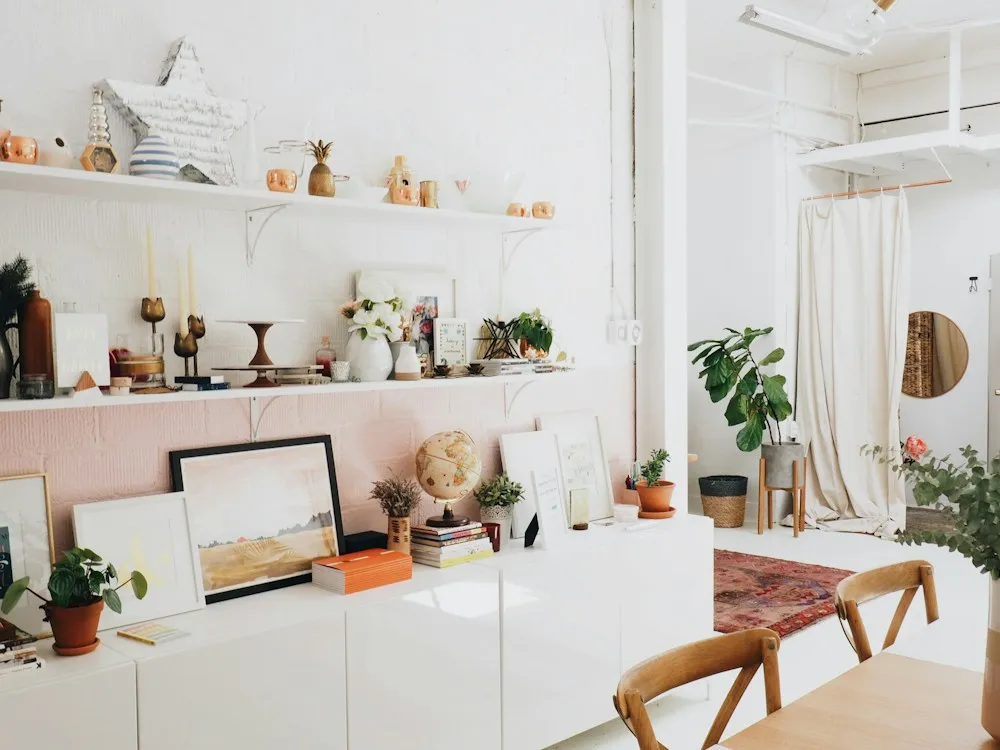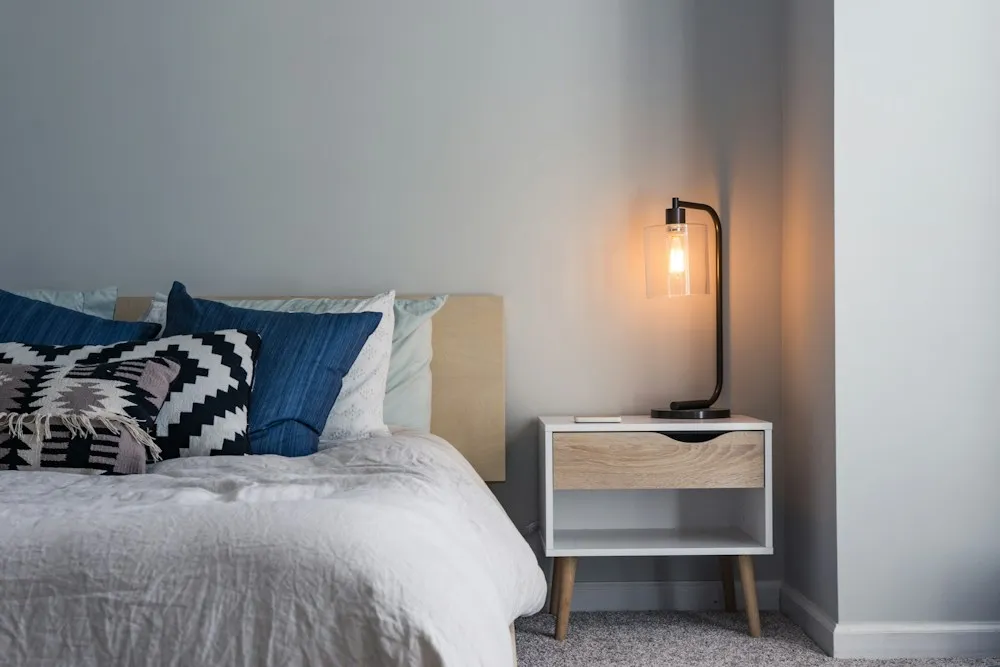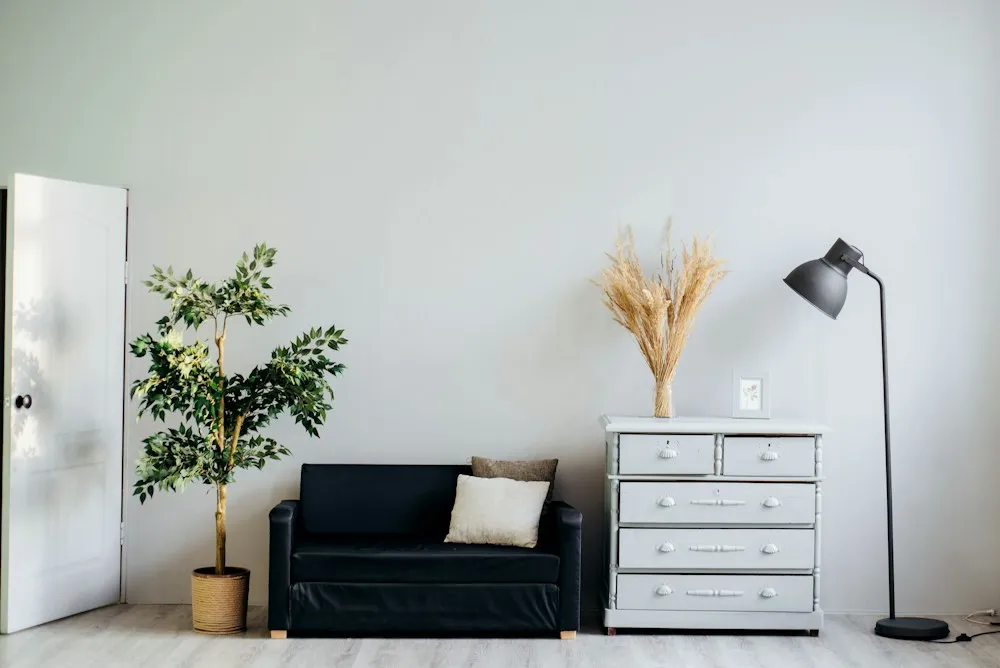
Eleven years of small-space consults and the story never changes. The client apologizes for the mess on the way in, explains that the apartment is simply too small, then walks me past four piles. Always four, always in the same four places.
Nobody has a clutter problem in the abstract. What they have is four landing strips and nothing designed to catch what lands on them.
The four places things actually accumulate
A landing strip is the first flat surface your hands find once they are full. You do not choose it; your route through the home chooses it, set by where the door is and where you sit down. In a small place it is almost always these four:
- Just inside the front door. Keys, mail, sunglasses, the parcel. It fills within ninety seconds of arriving, because nobody walks a set of keys to a drawer in another room.
- The end of the kitchen counter. The end nearest the door, or the one furthest from the sink. Paperwork, vitamins, chargers, a fruit bowl that stopped being about fruit years ago.
- The arm of the sofa, or the floor beside it. Remote, phone, glasses, a cable, two books. You spend your evenings here, so the objects of an evening live here.
- The chair in the bedroom. The famous one. Clothes too clean to wash and too worn to hang, on the only horizontal surface that is not the bed.
None of it is a character flaw. Each pile is an honest record of a real route through a real day, and you will not train it out of yourself.
Design for the behavior, not against it
So stop fighting the strips and furnish them. One designated vessel per strip, handsome enough that a full one still looks deliberate. That is the trick: a pile in a bowl is a still life, the same pile on bare wood is a mess. Naming the four strips out loud is the first thing bumfuzzledjane.com does in a small-space consult.
The front door
A tray, minimum 9 by 12 inches, on a console no deeper than 10 inches so it does not narrow the hall. Too tight for furniture? A wall-mounted ledge 4 to 5 inches deep at 42 inches does the same job. Add two hooks at 62 to 66 inches, and one shoe basket. One. When it is full, shoes get put away.
The kitchen counter
A lidded crock or a 12-inch wooden tray, and whatever lands there goes in it or gets dealt with. The lid matters more than it sounds: closed containers hold visual silence, open ones read as a pile with a border drawn around it. Put it where things already land, not where you wish they did.
The sofa
A sofa arm sits around 24 to 26 inches from the floor, which is exactly side-table height. A slim table 14 to 16 inches wide with a drawer absorbs a whole evening of objects, and it makes the seating group read as finished, a separate problem covered in why your room still feels unfinished.
The bedroom chair
Two honest options. Keep the chair, but stand a valet or a three-hook rail at 66 inches beside it so clothes hang rather than heap. Or swap it for a storage bench at the foot of the bed: 16 to 18 inches high, 42 to 54 inches long, lift-top, hamper inside. In a small bedroom the bench wins, because it is one footprint doing two jobs.
One rule across all four. The vessel has to be big enough for a bad day. An undersized bowl overflows within a week, and then it is a pile with an ornament in the middle of it.
The forgotten zone above 60 inches
In a small home the floor is fought over and the air is empty. Stand in any room you think is too small and look at the band between 60 inches and the ceiling. It is almost always doing nothing.
- Above doorways. Usually 12 to 16 inches of dead wall over an internal door. A shelf there takes towels, spare paper and whatever you reach for four times a year.
- Above the toilet. A cabinet with its underside at 48 inches clears heads and holds a whole bathroom of stock in roughly 30 by 8 inches.
- To the ceiling in the kitchen. Cabinets stopping at 84 inches with a dusty gap above give away 12 to 18 inches of the most useful storage in the house.
- The top 18 inches of a closet. A second rail, or matching lidded boxes, turns a shelf you cannot see the back of into storage you can index.
One caution. Do not fill eye level, roughly 48 to 62 inches standing. That band is what a room reads as. Store high, store low, keep the middle calm.
Furniture that stores, with the honest downsides
Dual-purpose furniture is sold as a free win. It charges in access rather than money, and the bill arrives daily.
Storage ottomans
Best for bulky, seldom-needed soft things: throws, a spare duvet, board games. Typically 18 to 22 inches square inside. The catch is that you clear the top to open it, so nothing you need daily lives in there. Buy the hinged lid, and look at the hinge, because the hinge is what fails.
Bed bases
The largest unused volume in most homes: 20 to 28 cubic feet under a standard queen. Drawer bases need 24 to 30 inches of clear floor beside the bed, which a small bedroom may not have. Gas-lift ottoman bases use the whole volume and need no side clearance, but you cannot open one without stripping the bed. Choose by clearance.
Lift-top coffee tables
Good for the remote-and-cable problem. Less good structurally: cheap mechanisms wobble inside two years, and the void is shallow, usually 4 to 5 inches. Treat it as a large drawer, not a cupboard.
None of them fix volume, which is why the next two sections matter more than this one.
In a small room, closed beats open
Open shelving photographs beautifully in a 2,400-square-foot house with three other rooms to balance it. In 500 square feet it is a wall of visual noise, and visual noise is most of what makes a small room feel small.
The working ratio is about 70 percent closed to 30 percent open. Keep the open third for things you would be happy to have photographed: books, three ceramics, one plant. Everything functional goes behind a door. Cane, reeded glass and fabric fronts all count as closed and beat flat slab doors, because they break up the plane. If the open shelves are staying, buy matching boxes: six identical lidded boxes read as one object, six mismatched ones read as six.
The one-in-one-out shelf
Designate one shelf, drawer or basket as the limit. This is not a decluttering project, which reverses within four months. It is a valve, and it costs four minutes a week.
Pick the category that actually grows in your home: mugs, tote bags, candles, cables, school artwork, skincare. Give it one container. When something new arrives and the container is full, something leaves that day, and not to a maybe box in the garage, which is the same pile with a longer commute. It works where tidying does not because it moves the decision to the moment of purchase, the only moment at which it is cheap.
Measure before you buy a single box
The most common small-space mistake in my inbox is a storage purchase that does not fit. A 36-inch bench in a 33-inch alcove. A wardrobe whose doors hit the bed. Storage furniture is boxy, heavy and non-returnable once assembled.
Take the twenty minutes. Measure the opening at floor level and again at the top, because old walls are not parallel. Measure the route in: front door, hall turn, stair landing, doorway. Measure the clearance a drawer or door needs. The full routine is in measure twice, buy once. Then tape the footprint on the floor and live with it for two days.
When an hour of outside judgment beats more baskets
Most small-space problems are layout problems wearing a storage costume. If the sofa is in the wrong place, no quantity of baskets fixes the route, and people buy baskets first because a basket is easier to order than a decision.
That is why bumfuzzledjane.com sells a ninety-minute Design Direction Call at $295 rather than a shopping list. You walk the space on camera, we name the four landing strips, and you leave with a short list of what to move and what to stop looking at. If the room needs a scaled plan and a furniture schedule, that is a Room Design Plan, listed with the rest of our consulting services alongside results in recent projects.
Or photograph your four landing strips and get in touch. Half the time the answer is one sentence and costs nothing, and there is more in the journal.